
How many restrooms does a county fair need?
Start with attendance, not acreage. A fairground pulling 2,000 people through the gate on a Saturday needs a different count than a Tuesday preview night, and our placement guide walks through the math event organizers actually use. Most fair layouts land somewhere between standard units for general crowd flow and a couple of deluxe flushable units near the grandstand or beer tent, where people expect something closer to a real restroom. If your fair runs a livestock barn or 4-H building, treat that as its own zone with its own count, since exhibitors and families linger there longer than midway traffic.
ADA Standards section 213.2 requires that where single-user units are clustered, at least 5 percent must be accessible, never fewer than one per cluster. That means a bank of eight standard units needs an ADA accessible unit sitting right in the row, not tucked behind the food trucks. ADA Standards section 304.3.1 also calls for a 60 inch turning circle at the unit, so the pad underneath it has to be flat and wide enough, and ADA Standards section 405.2 caps any ramp at a 1:12 slope if the ground isn't level. Waterbury fairgrounds sit on varied terrain, so we walk the site before drop-off. Fairs near Bristol, about 11.9 miles northeast of Waterbury, often deal with the same sloped-lot problem on old agricultural land.
What does restroom rental for a fair cost?
Pricing runs by the day for short fairs and by the week for anything running multiple days back to back. Here's what a fair-scale order typically looks like:
| Unit | Day | Week |
|---|---|---|
| Standard unit | $100 - $350 | $130 - $500 |
| ADA accessible unit | $200 - $400 | $240 - $400 |
| Deluxe flushable unit | $85 - $1,200 | $150 - $290 |
| Delivery fee | $100 - $500 | $150 - $200 |
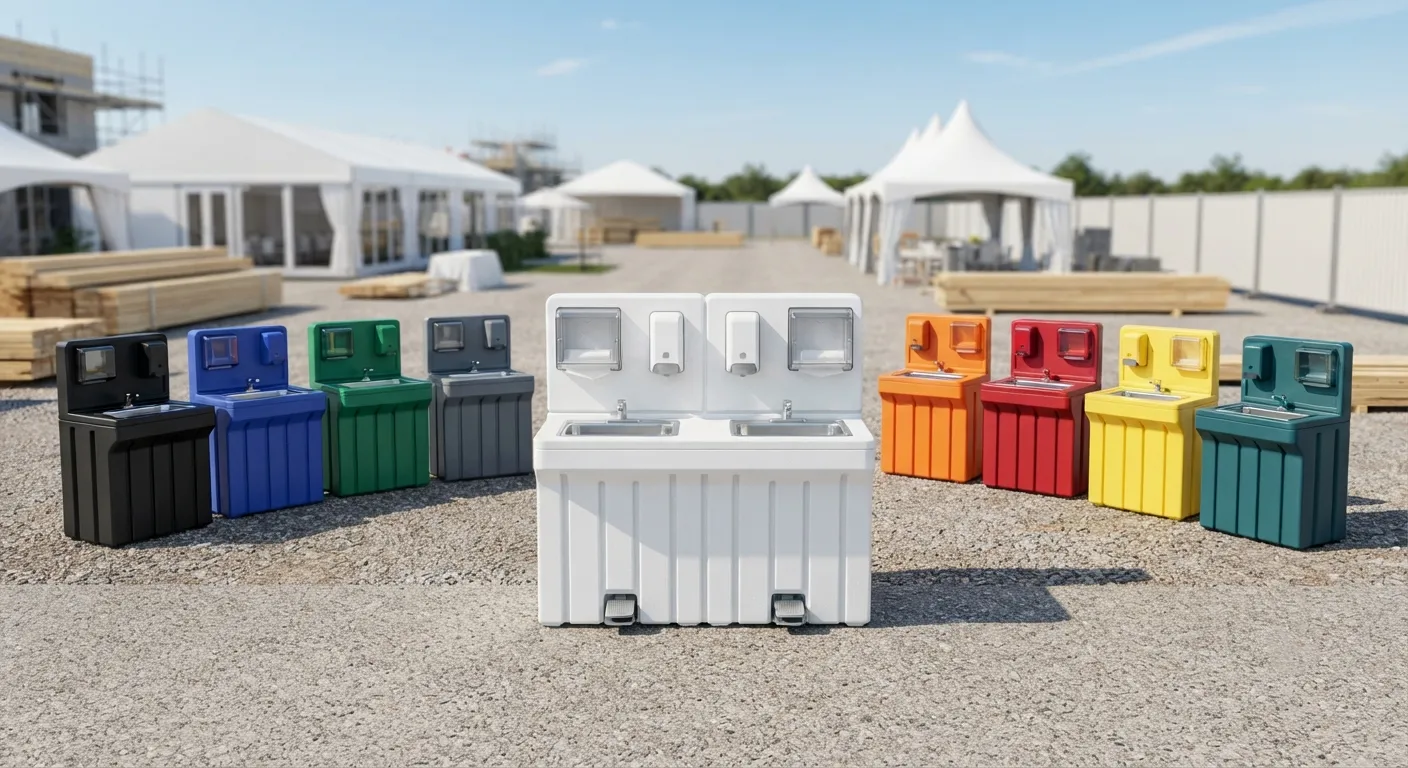
A three-day fair usually books the week rate rather than three separate day rates, since it comes out cheaper per unit. Add a handwashing station near any food vendor row. 29 CFR 1910.141(d)(2) requires soap and towels or a hand-drying device at washing facilities, and hand sanitizer alone doesn't satisfy that standard, which matters if your fair has a health inspector walking the midway. For the full cost breakdown across unit types, see our porta potty rental cost page, and if you're comparing day rates against weekly totals, porta potty rental per day has more detail.
If your fair runs a grease-heavy food court, a grease trap or interceptor may need service too, since fats, oils, grease and solids get pumped once they reach 25 percent of the liquid depth. Fair season in Connecticut often means back-to-back bookings across towns, and Southington, 12.4 miles east of Waterbury, and Meriden, 15.2 miles east, both run fairs on similar calendars, so book early.
Where should restrooms go on a fairground?
Spread them across the grounds rather than clustering everything by one gate. A good layout puts units near the midway, near the grandstand, near livestock barns, and near any beer garden or ticketed area, each as its own mini-cluster with its own accessible unit under ADA Standards section 213.2. Waterbury Porta Pros lays units on a path at least 36 inches wide, per ADA Standards section 403.5.1, so wheelchairs and strollers can pass without squeezing. ADA Standards section 302.1 also requires the ground surface itself be stable, firm and slip resistant, which rules out setting units directly on loose gravel or soft turf without a base pad.
Keep units away from food prep and away from the animal barns' downwind side. A standard unit runs about 44 by 48 inches on the ground and stands roughly 92 inches tall, so it fits in most tight fairground corners without eating up vendor space. For bigger fairs expecting heavy multi-day traffic, a restroom trailer or an 8 stall restroom trailer near the main gate cuts down on lines better than a long row of standard units. Some fair boards also rent a 4 stall restroom trailer for VIP or sponsor areas. Waterbury's larger fairground sites usually need temporary fencing too, to keep restroom zones and dumpster pads separated from public paths, and a roll-off dumpster placed near the food court handles fair trash without overflowing by Sunday.
What if a fair runs longer than a weekend?
Multi-day fairs should book the weekly rate rather than several daily rentals, since the total comes in lower per unit. Our monthly porta potty rental page covers longer bookings if your fair stretches past a week, which some harvest festivals do.
Do we need a permit to place restrooms on fairground property?
Placement in a public right of way needs confirming with the City of Waterbury before delivery. Most fairgrounds sit on private or leased land, but check with the venue and city first. See our porta potty permit requirements page for what to ask.
How often do restrooms get serviced during a multi-day fair?
Daily servicing is standard for fair-scale events with heavy foot traffic, well above the ANSI/PSAI Z4.3 baseline of once weekly for lighter use. Our servicing FAQ explains what a service visit includes.
Can we get restrooms delivered the same week as our fair?
Often yes, depending on the date and how many units you need. Check our emergency porta potty rental page, and request a quote early since fair season books up fast across nearby towns.
What size crew needs restrooms too, not just attendees?
Vendors, staff and livestock handlers count separately from gate attendance. If your fair runs like a job site with paid crew on the grounds, OSHA 1926.51(c) toilet ratios may apply to that crew count.
Next step
Get a delivery date
Tell us the address, the dates and the headcount. We size the order and confirm the route.